

Stitch Screws in Roofing: Purpose, Placement & Common Site Mistakes
Stitch Screws in Roofing: Purpose, Placement & Common Site Mistakes
- Roofix
Why Stitch Screws Deserve a Separate Explanation
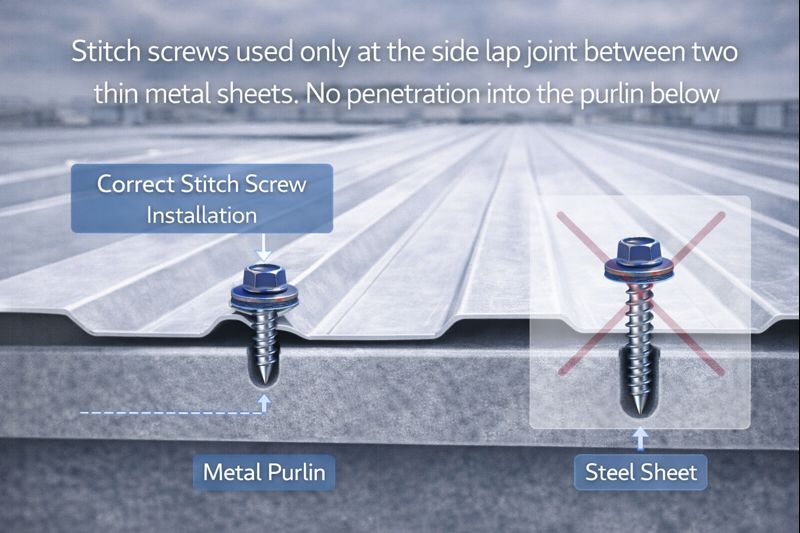
In most roofing projects, stitch screws are treated as an afterthought—small, inexpensive, and often selected at the last moment. On site, they’re commonly grouped under “regular roofing screws,” despite serving a very different purpose. This assumption is where many long-term roofing issues quietly begin.
Stitch screws are not designed to carry structural loads or penetrate supporting members. Their role is precise: securing overlapping metal sheets and cladding joints. When used correctly, they improve sheet alignment, reduce vibration, and help maintain consistent lap joints. When misused, they contribute to sheet distortion, water ingress, and premature corrosion—problems that usually appear long after installation.
The reason stitch screws deserve a separate explanation is simple: they are application-specific fasteners. Treating them like full-length roofing screws leads to incorrect fixing practices on industrial and commercial roofs. Understanding what stitch screws are meant for—and where they should never be used—is essential for ensuring long-term roofing performance and avoiding avoidable site failures.
What Are Stitch Screws? (And What They Are Not)
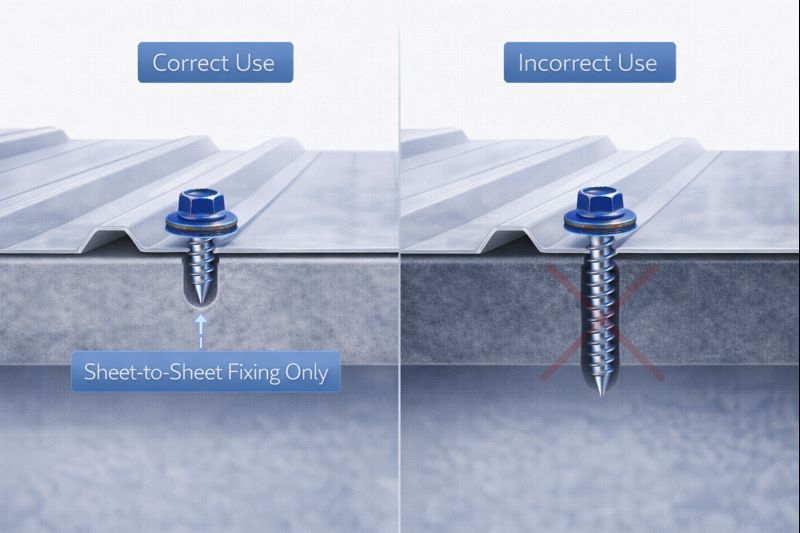
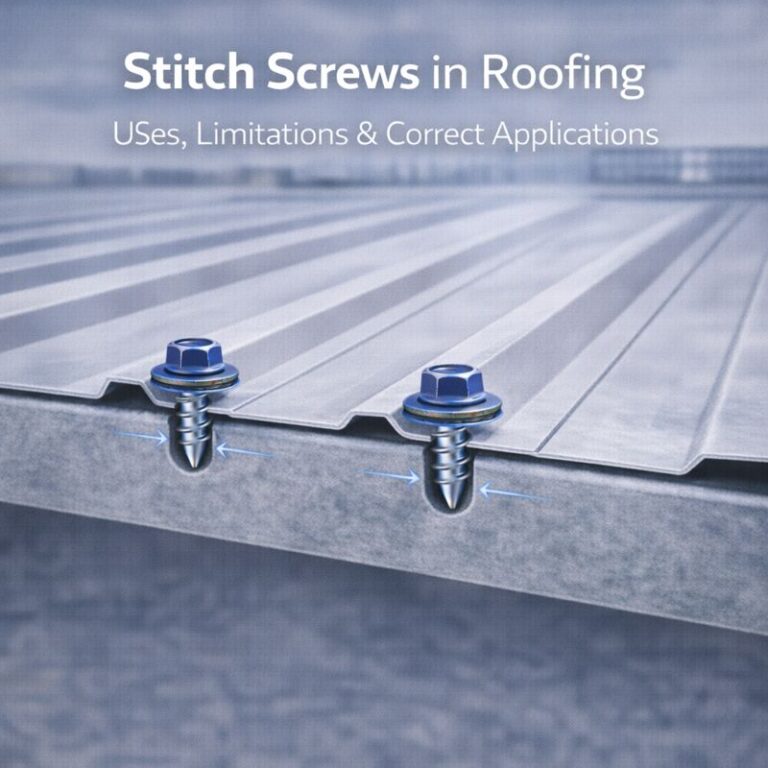
Stitch screws are short-length fasteners specifically designed for sheet-to-sheet fixing, not for structural connections. Their primary function is to secure overlapping metal sheets or cladding panels at side laps and end laps, where alignment and tight contact between sheets is required.
Unlike full-length roofing screws, stitch screws are not intended to penetrate purlins, trusses, or any supporting framework. They typically engage only thin metal layers and rely on precise thread grip rather than depth or load-bearing capacity. This is why stitch screws are manufactured in shorter lengths and often without sealing washers used in primary roofing fasteners.
What stitch screws are not:
They are not structural fasteners
They are not a replacement for roofing or self-drilling screws
They are not designed to provide waterproofing at fixing points
They are not meant to handle wind uplift or dynamic loads
Understanding this distinction is critical. Using stitch screws beyond their intended purpose compromises roof integrity, even if the installation initially appears secure. Correct identification and application are what separate durable roofing systems from ones that fail prematurely.
Where Stitch Screws Are Commonly Used
Stitch screws are used in specific locations where the goal is alignment and sheet stability, not structural strength. On well-executed roofing projects, their placement is limited and intentional.
Common, correct use cases include:
Side laps of metal roofing sheets
Used to hold overlapping sheets firmly together, preventing fluttering, rattling, or separation under wind movement. Stitch screws help maintain uniform lap contact across long sheet runs.End laps and cladding overlaps
Applied where metal sheets or wall cladding panels overlap each other, ensuring tight contact without engaging the supporting structure beneath.Non-structural sheet connections
Used in areas where sheets need temporary or secondary fixing for alignment, positioning, or vibration control—without carrying load or resisting uplift forces.Edge control in large sheet spans
Helps maintain straight edges and consistent sheet lines, especially in wide roofing panels where thermal movement can cause minor displacement.
Stitch screws work best when their role is limited to sheet-to-sheet control. Once they are expected to perform beyond this—such as resisting wind uplift or acting as primary fixings—the roof system becomes vulnerable to long-term performance issues.
Stitch Screws vs Roofing Screws
Although they may look similar at first glance, stitch screws and roofing screws serve very different roles. Confusing the two is one of the most common causes of fixing-related roof issues on site.
Key Differences at a Glance
| Parameter | Stitch Screws | Roofing Screws |
|---|---|---|
| Penetration Depth | Short – limited to sheet thickness only | Long – penetrates sheet and structural member |
| Load Bearing | Non-structural | Structural (resists uplift and movement) |
| Waterproofing Role | No primary sealing function | Designed to seal fixing points |
| Washer Usage | Usually without EPDM washer | Typically used with EPDM washer |
| Primary Purpose | Sheet-to-sheet alignment and stability | Sheet-to-structure fixing |
This distinction matters. Stitch screws are precision fasteners meant for control and alignment, while roofing screws are engineered for strength, sealing, and long-term durability. Using one in place of the other compromises the entire roofing system.
Common Mistakes When Using Stitch Screws on Site
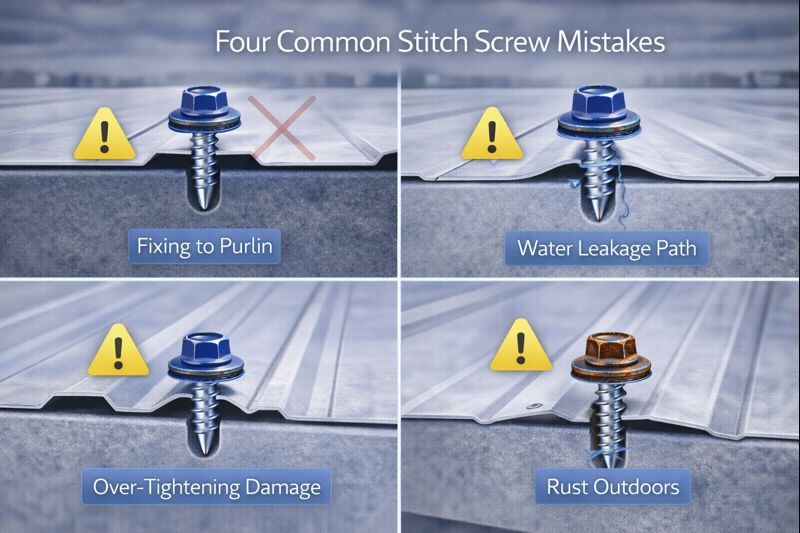
Stitch screws often fail not because of poor quality, but because they are used outside their design intent. These mistakes usually don’t show immediate issues—but show up months later as leaks, noise, or sheet damage.
Most common site-level mistakes include:
Using stitch screws for purlin fixing
Stitch screws lack the length and thread engagement needed to anchor into structural members. When used in place of roofing screws, they lead to loose sheets and uplift failures.Assuming waterproofing performance
Stitch screws are not sealing fasteners. Without EPDM washers, they cannot prevent water ingress—especially at horizontal laps exposed to rain flow.Over-tightening thin metal sheets
Excessive torque deforms sheets around the screw head, causing oil canning, cracks, and long-term corrosion at stressed points.Using the wrong coating in outdoor roofs
Indoor-grade or low-corrosion coatings fail quickly in external environments, leading to rust streaks and weakened fixing points.
Avoiding these errors ensures stitch screws perform their intended role—control and alignment, without becoming a hidden failure point in the roofing system.
Technical Specifications That Actually Matter
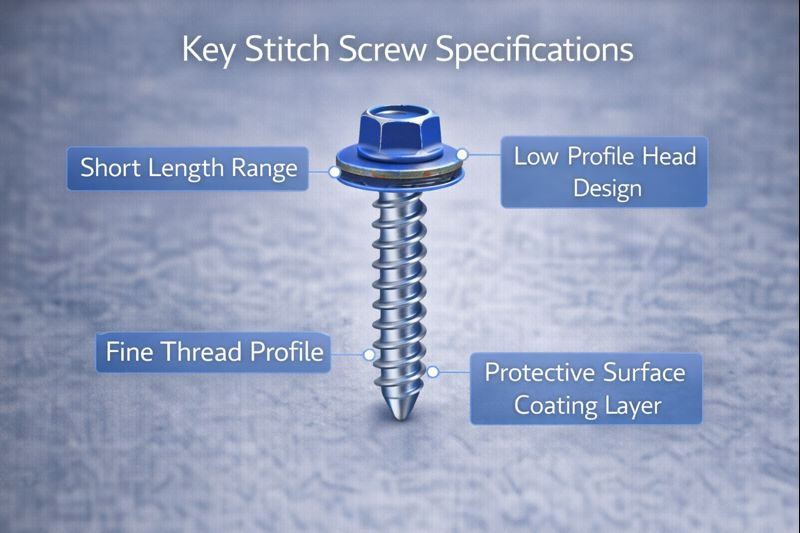
When selecting stitch screws, site teams don’t need spec sheets filled with numbers—they need clarity on what affects performance on the roof. These are the specifications that genuinely matter in real-world applications.
Length range
Stitch screws are typically short, designed only to pass through overlapping sheets. Excess length increases the risk of unwanted structural contact or sheet deformation.Thread type
Fine or sharp-point threads ensure clean penetration through thin metal without tearing or enlarging the hole—critical for maintaining tight sheet contact.Head type
Low-profile heads (such as wafer or pan heads) help distribute pressure evenly across the sheet surface, reducing the chance of pull-through or visual distortion.Coating relevance
Even though stitch screws are non-structural, coating quality still matters—especially in exposed or outdoor environments. Inadequate coatings lead to early corrosion at lap joints.
(Related reading: internal link opportunity — Why Screw Coating Matters in Roofing Projects)
Understanding these few parameters helps teams avoid overspecifying—and more importantly—misusing stitch screws on site.
When Stitch Screws Should NOT Be Used
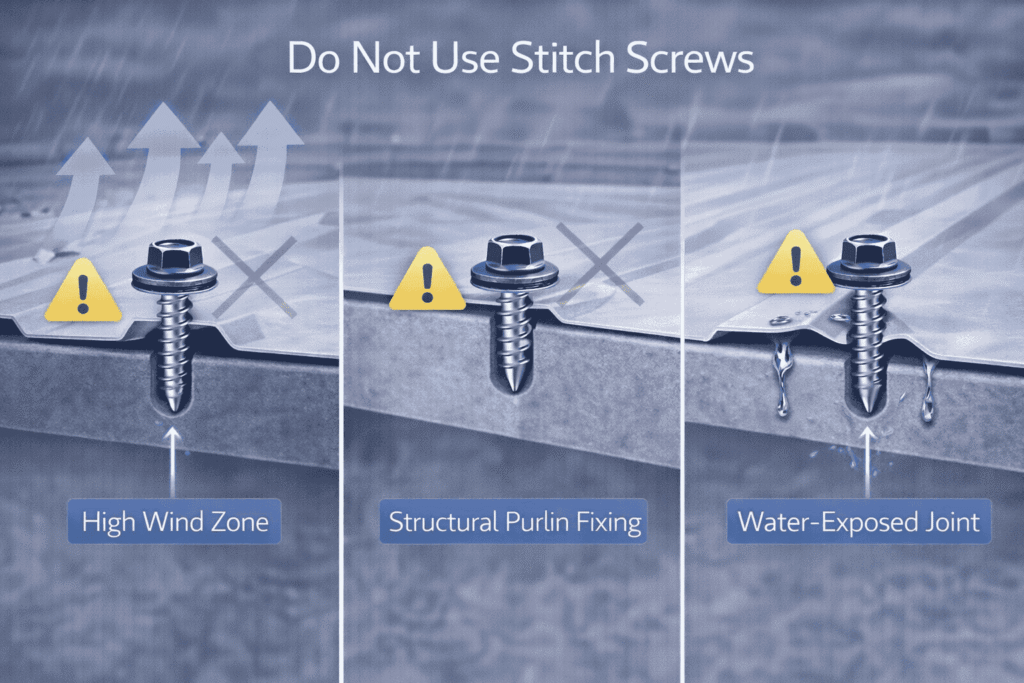
Stitch screws are highly effective within their intended role—but using them outside that scope introduces unnecessary risk. Knowing where not to use them is just as important as knowing where they work.
Stitch screws should be avoided in the following situations:
High wind load roofs
Areas exposed to uplift forces require structural fasteners with deep penetration and pull-out resistance. Stitch screws are not designed to handle these loads.Primary structural fixing
Stitch screws should never replace roofing screws for anchoring sheets to purlins or framing members. They lack the required length, thread engagement, and load-bearing capacity.Waterproof joints
Joints exposed to direct water flow or ponding demand sealing fasteners with EPDM washers. Stitch screws do not provide reliable waterproofing on their own.
Using the right fastener in the right location ensures the roof performs as designed—without relying on assumptions that lead to failure later.
Roofix Stitch Screws – Designed for Sheet Overlaps
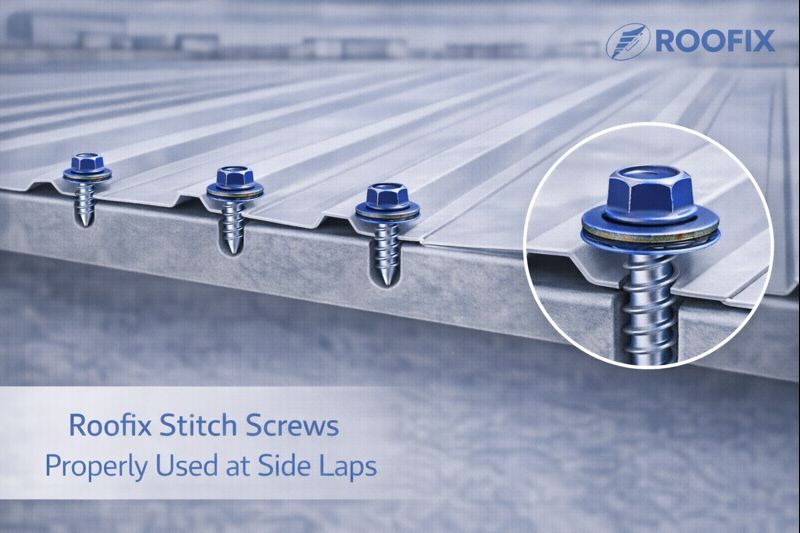
Roofix stitch screws are engineered specifically for sheet-to-sheet fixing, where alignment, stability, and long-term consistency matter more than structural load capacity.
They are available in controlled length ranges suitable for metal roofing side laps and cladding overlaps—helping site teams avoid over-penetration or unintended contact with structural members.
Designed for non-structural applications, Roofix stitch screws focus on:
Clean penetration through thin metal sheets
Stable holding without sheet distortion
Coating consistency for predictable outdoor performance
Most importantly, they are manufactured with tight dimensional control, ensuring uniform behavior across large projects—reducing variability that often leads to installation errors or uneven roof performance.
By clearly defining where stitch screws belong in the roofing system, Roofix supports better on-site decisions and more reliable outcomes over the roof’s lifecycle.
Conclusion – Using the Right Screw for the Right Job
Roofing failures rarely happen because of one big mistake—they happen because of small shortcuts taken repeatedly. Fastener selection is one of those decisions that may seem minor during installation but defines long-term roof performance.
Stitch screws play an important role when used correctly: holding sheet overlaps stable, aligned, and secure. Problems arise only when they are asked to do jobs they were never designed for.
By understanding application limits, load expectations, and exposure conditions, project teams can:
Prevent premature corrosion and sheet damage
Reduce post-handover maintenance issues
Ensure consistent performance across the entire roof lifecycle
In roofing, performance is built through informed choices, not assumptions. Choosing the right screw for the right job is one of the simplest ways to protect the integrity of the whole system.
Share on
Recent posts
Stitch Screws in Roofing: Purpose, Placement & Common…

Screw Length & Diameter Selection Guide for Roofing…
Self Tapping Screws: Types, Uses & Selection Guide
Get a free Estimate
Related Posts
Stitch Screws in Roofing: Purpose, Placement & Common Site…
Stitch Screws in Roofing: Purpose, Placement & Common Site Mistakes Stitch Screws in Roofing: Purpose,…
Screw Length & Diameter Selection Guide for Roofing Applications
Screw Length & Diameter Selection Guide for Roofing Applications Screw Length & Diameter Selection Guide…
Self Tapping Screws: Types, Uses & Selection Guide
Self Tapping Screws: Types, Uses & Selection Guide Self Tapping Screws: Types, Uses & Selection…
